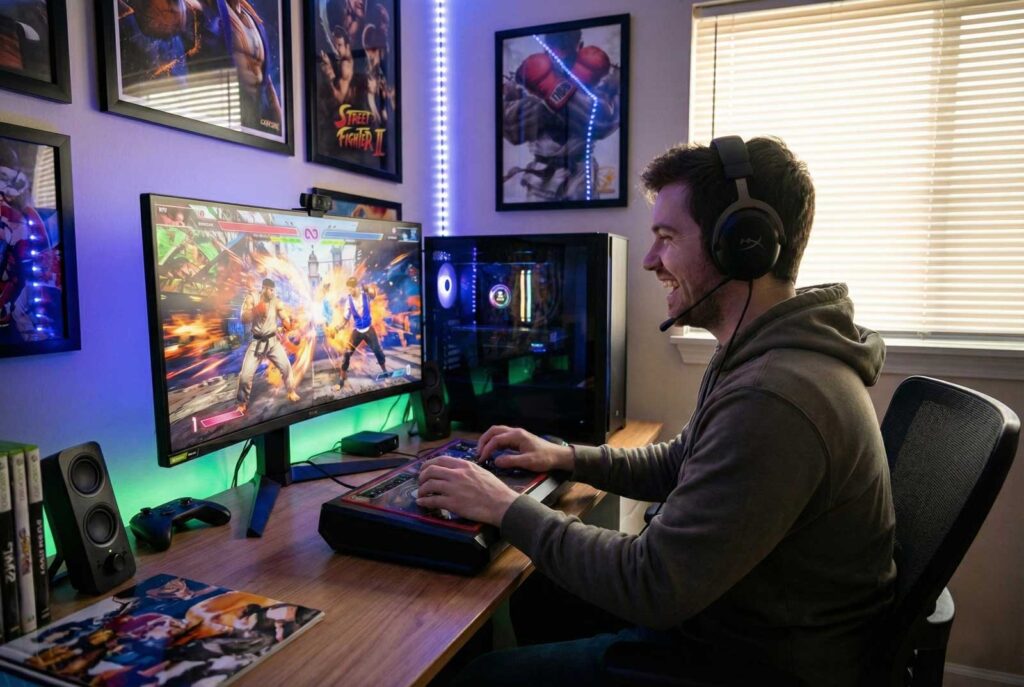
Chen unpacks his fight stick at the game store. It’s Thursday at 7 PM. Last week, five people showed up for casuals. Tonight, it’s just him and one other player who only wants to run the same matchup for twenty minutes. He rechecks the local Discord. Three people said they’d come. Two bailed an hour ago. He loves Street Fighter, spent hundreds of hours learning combos and frame data, but the community he craves exists primarily in highlight reels and Twitter threads.
The fighting game community has always thrived on in-person connection. Before online play became standard, players gathered at arcades, forming rivalries and friendships over quarters and long sets. Today, the scene looks different. Local meetups happen sporadically. Discord servers overflow with players who never actually meet up. This kind of gaming loneliness hits harder when you consider what makes fighting games special. You need someone across from you, learning your patterns while you learn theirs.
Finding consistent training partners feels like its own competitive challenge. Using Gamily to connect with compatible players who share your schedule and competitive goals eliminates the guesswork that kills most practice partnerships before they start.
Key Takeaways
Here’s what you need to know:
- What Makes It Unique: The fighting game community operates on one-on-one competition where every loss is personal and every improvement requires training partners, creating deeper social bonds than team-based games.
- How It’s Organized: The ecosystem consists of local meetups for hands-on practice, Discord servers for coordination, and content platforms that spread knowledge across regions.
- Common Challenges: Finding consistent training partners, managing competitive frustration, and identifying healthy communities create barriers for newcomers.
- Entry Points: Players can start through beginner nights, character-specific groups, or small local tournaments for immediate feedback.
Why Fighting Games Feel Different
Competitive fighting games operate under entirely different social rules than team-based games. Every match puts two people in direct conversation. You cannot hide behind teammates. You cannot blame RNG. When you lose, you know exactly why, and the person who beat you is sitting right there, ready to run it back.
The player who beats you 10-0 today might be the same person explaining your mistakes tomorrow. Rivalries form not from trash talk but from mutual recognition. These connections build a social fabric based on direct engagement, where respect flows naturally from understanding someone’s game plan.
Fighting games require sparring partners to progress. You cannot learn by timing tech against AI. You cannot practice neutral spacing in training mode alone. You need live opponents who adapt, who punish your habits, who force you to evolve. This dependency transforms improvement from a solo grind into a collaborative process.
Skill determines bracket placement. Participation determines social standing. These operate independently. The player who places last at every event but studies replays, asks thoughtful questions, and celebrates others’ wins becomes a valued member.
Choosing Your Entry Point
The fighting game scene offers distinct entry paths. Pick based on what you want from the experience.
Character-specific channels and matchup discussion groups operate like study groups. Members share technology, review replays collectively, and organize training sessions around concrete learning objectives. If you want to understand a character’s optimal gameplan, focused communities provide faster answers than scattered practice. Social bonds form naturally when you work toward shared goals with people who take development seriously.
Small local brackets teach you what tournament experience actually feels like. You discover how pressure affects your execution. You identify which parts of your gameplan crumble under stress. Many successful players compete frequently from day one, treating every tournament as data collection rather than high-stakes evaluation.
How to Become Someone People Want to Play Again
Social awareness gets you practice partners. The players who find consistent training opportunities understand unwritten rules that make someone enjoyable to run sets with.
Timing your request changes the outcome completely. Asking someone for games while they’re warming up before their tournament match gets you a polite decline. Catching them during casual hour gets you an immediate yes. Be specific about what you want. “I need practice against your character. Can we run a first-to-five?” tells them precisely what you’re asking for.
After the agreed number of games ends, check in verbally. “Want to keep going?” gives the other person an easy exit. Pay attention to nonverbal cues during extended sessions. If your opponent starts playing noticeably more autopilot, they’re getting tired. Ending on a good note matters more than squeezing out extra games. The player who knows when to stop gets invited back next week.
Generic praise becomes background noise. Specific observations show you were paying attention. “That meaty timing caught me every time” acknowledges what they did well. Give one actionable point when someone asks for advice. Multiple critiques at once overwhelm them with nothing to focus on.
Managing Salt Without Damaging Relationships
Every loss is personal. Every mistake is visible. The pressure to improve while maintaining relationships with your practice network creates tension that ends friendships if handled poorly.
Frustration hits everyone after critical drops, repeated losses to the same setup, or getting blown up by someone you expected to beat. The emotion is legitimate. How you express it determines whether people want to play with you tomorrow. Slamming controllers, making excuses, or blaming the game permanently pushes practice partners away.
Take a breath before speaking after a frustrating loss. Walk away from the setup for two minutes. Create space between the emotion and your reaction. Your practice partners understand salt because they’ve felt it themselves. They just need to see you handle it without poisoning the environment.
Identifying Healthy Communities
Online fighting game communities vary wildly in culture. Some accelerate your growth and make the game more enjoyable. Others drain your time and stall your progress.
Unchecked trash talk in beginner channels tells you everything. When experienced players mock newcomers for asking basic questions and moderators don’t intervene, you’re looking at a scene that doesn’t value growth. When Discord channels spend more time discussing interpersonal conflicts than the actual game, priorities are misaligned.
Visible moderation with clear rules shows the community takes the environment seriously. Organized resources for new players indicate the scene invests in development. Pinned guides, character channels with curated information, and dedicated beginner practice times show the community wants people to improve.
How Gamily Supports Fighting Game Players
Finding practice partners currently means scrolling through Discord hoping someone’s available, posting in Reddit threads that get buried in hours, or showing up to locals praying for a good turnout.
Gamily shows you compatibility information upfront so you can connect with players who actually fit your gaming lifestyle. Your profile shows exactly which fighting games you play and which platforms you own. When someone matches with you, you both know you can actually play together right now.
The most significant barrier to building practice partnerships is mismatched availability. You’re free Tuesday and Thursday evenings. Your potential training partner plays Saturday mornings. You connect on Discord but never actually run sets because your schedules never overlap. Gamily includes schedule availability in matching criteria, solving the coordination problem that kills most partnerships before they start.
The app lets you set your intent explicitly. You can look for training partners while remaining clear that it’s platonic. This clarity eliminates mixed signals and makes every conversation start with aligned expectations.
Download Gamily and find training partners who match your schedule and goals.
FAQs
What is the best fighting game for complete beginners?
Street Fighter 6 offers the most beginner-friendly experience with modern controls that simplify execution. Guilty Gear Strive and Granblue Fantasy Versus Rising also welcome newcomers through strong tutorials. Pick based on the art style that appeals to you.
How long does it take to get good at fighting games?
Expect six months to feel competent and understand basic situations. Reaching a competitive level typically takes two years of consistent practice. Progress depends on practice quality and training partners.
What is frame data, and do I need to learn it?
Frame data measures how fast moves execute and recover. Beginners gain more from learning spacing and anti-airs first. Understanding frame data becomes important around the intermediate level when optimizing punishes matters.
How do I overcome ladder anxiety in fighting games?
Treat ranked matches as practice with stakes removed. Losing teaches more than winning when you review what went wrong. Set goals around learning rather than rank. Most ladder anxiety fades after fifty matches.